
Land Rover Range Rover (1970 – 1996) Review
.jpg?width=640&height=426&rmode=crop)
.jpg?width=640&height=426&rmode=crop)
.jpg?width=640&height=426&rmode=crop)
.jpg?width=640&height=426&rmode=crop)
.JPG?width=640&height=426&rmode=crop)
.JPG?width=640&height=426&rmode=crop)
.JPG?width=640&height=426&rmode=crop)
.JPG?width=640&height=426&rmode=crop)
.JPG?width=640&height=426&rmode=crop)
.JPG?width=640&height=426&rmode=crop)
.JPG?width=640&height=426&rmode=crop)
.JPG?width=640&height=426&rmode=crop)
.JPG?width=640&height=426&rmode=crop)
.JPG?width=640&height=426&rmode=crop)
.JPG?width=640&height=426&rmode=crop)
.JPG?width=640&height=426&rmode=crop)
.JPG?width=640&height=426&rmode=crop)
.jpg?width=640&height=426&rmode=crop)
Land Rover Range Rover (1970 – 1996) At A Glance

 Classless styling, a design icon, excellent on-road, unstoppable off-road, V8 engine and transmission a known quantity, practical, brilliant parts and technical support
 Some early parts of unobtainable, the fashionista has taken the Range Rover to its collective bosom so values are sky-rocketing - bad if you're hoping to buy one
The Range Rover might not have been the first luxury off-roader - that honour probably went to the Jeep Wagoneer - but in Europe, it soon became the most recognisable of the lot. And for many, that means it's still the instigator of the luxury SUV as a breed. But what makes the Range Rover so special is that it has remained an utterly classless conveyance, despite the negative public image of many newer rivals.
It was powered by Rover’s ex-Buick V8 and using chassis technology similar to the Land Rover's, its off-road ability was beyond reproach, while the hose-clean interior proved just the ticket for those with an active lifestyle. Styling was so lean that the Range Rover was at home in the politest places. It became ever-more luxurious and its appeal remained undimmed during a 25-year run. Exceptional cars, such as the earliest examples, or tidy CSK special editions, can name ther price, and are rising in values.
Ask Honest John
What is an upmarket replacement for my Honda CR-V?
Classic car insurance - market value vs agreed value
Model History
- June 1964: Rover looks to build a new vehicle to increase sales in the USA
- February 1965: New V8 chosen to power the latest off-road Rover, codenamed 100-inch Station Wagon
- January 1967: First 100-inch Station Wagon mock-up built
- September 1967: 100-inch Station Wagon full-sized prototype built
- March 1968: David Bache restyled the prototype
- June 1970: Range Rover launched to the press
- January 1971
- January 1972: Range Rover becomes the first vehicle to cross the Darrien Gap
- January 1973: First major revisions
- January 1974: Trim upgrades
- January 1975: More options added
- January 1976: Range Rover tweaked
- January 1977: Better view back
- January 1978: Gearing improvements - at a price
- March 1979: Land Rover becomes a separate company within BL
- May 1980: Monteverdi five-door Range Rover launched
- September 1980: Schuler launches Range Rover automatic transmission conversion
- October 1980: Range Rover In Vogue special edition launched
- July 1982: Factory autos and five-doors now in production
- January 1983: Range Rover five-speed launched
- August 1984: Vogue production model launched
- January 1985: Transmission improvements
- January 1986: Range Rover gets VM diesel
- January 1987: Front end restyle
- January 1988: More tweaks
- September 1989: 3.9-litre V8 replaced 3.5
- January 1990: CSK special edition launched
- January 1991: All models receive anti-roll bars and the manual gearbox is slightly upgraded.
- May 1992: Long-wheelbase Range Rover launched
- September 1994: Range Rover P38 launched, Classic remains in production
- February 1996: Range Rover Classic production ended
June 1964
Rover looks to build a new vehicle to increase sales in the USA
Thanks to the success of the newly-launched Ford Bronco and Jeep Wagoneer, the big growth area was in this market. By this time, Spen King had joined Gordon Bashford at the Rover Company, and it was both these men that put their minds to developing a car that would compete in this market.
One thing that King felt in developing a suspension system for any car designed for this market, was the need for massive wheel travel and low-rate springs (which went against the thoughts that Brian Sylvester had in the direction of interconnection) because it would offer excellent bump-absorbency. More importantly, long suspension travel also ensured that the wheels would remain in contact with the ground more of the time, something essential for good off-road ability.
February 1965
New V8 chosen to power the latest off-road Rover, codenamed 100-inch Station Wagon
Engine-wise, there was no contest: the V8 engine had been recently bought into the fold, thanks to William Martin-Hurst, and it would prove to be the ideal power unit for the new car. Torque characteristics favoured the bottom end of the rev-range, and because of its aluminium construction, it weighed 200lbs less than the in-line 3-litre engine that would have been used had it not been for the introduction of the V8. This was early 1966, and the project was still very much in its infancy, and yet it looked so promising that Peter Wilks gave the project the go-ahead for further development.
Gordon Bashford devised the finer points of the car in the following months: a box-section chassis, which had long-travel suspension, low rate springs and the V8 engine. Unlike the Land Rover, the new car would have its four-wheel-drive syste, permanently engaged – primarily to ensure that the massive torque of the V8 was split evenly between two lightly loaded axles. The wheelbase of the new car was 99.9-inches, which was rounded up in the car’s name – in a nod to the earlier project, it became known as the 100-inch Station Wagon.

David Bache always wanted the 100-inch Station Wagon to look more like a car, less like the boxy and utilitarian device that was the Land Rover. This early clay model shows the way he wanted the design to go.
January 1967
First 100-inch Station Wagon mock-up built
The body was designed for simplicity of construction – being comprised of simple aluminium panels bolted to a steel skeleton. Throughout 1966, this concept was developed, and the first full-size mock-up was ready for January 1967.
As can be seen in the accompanying photograph, it was this prototype formed the basis of the eventual design, and although it had been pretty much styled by Spen King and Gordon Bashford simply to clothe the mechanicals, they had received assistance from the styling department in order to give it acceptable proportions.

Accident in design: the 100-inch Station Wagon prototype was built up under the close scrutiny of Spen King and Gordon Bashford, and the body style in this photograph was intended only as a temporary measure in order to clothe the running gear, whilst David Bache devised the definitve design. However, the management of the company liked this proposal so much, they asked for it to remain, with only the lightest of changes.
As recounted many times elsewhere, 1966 marked the time when the Rover Company was bought out by the Leyland Motor Corporation, but it was not until the early months of 1967 that Donald Stokes’ team actually scrutinized the new car. On the first viewing, Donald Stokes and John Barber were both tremendously excited by the 100-inch Station Wagon (as they were the Rover P8, that was also under development at the time) and gave it the green light for further development. From this point, the future of the car was sealed – and whilst Peter Wilks’ engineering department knuckled down to the task of finalising the mechanical specification, David Bache’s studio was given the task of tidying the King/Bashford style into something more stylish.
September 1967
100-inch Station Wagon full-sized prototype built
Because it was based entirely on Bashford and King’s original design, it looked spartan in the extreme – however it proved very capable in testing. The concept was good – and everyone within Rover knew that this time, they had got everything right. David Bache, meanwhile, worked on his task of cleaning up the design, but as can be seen in the styling photographs, very little was changed, and certainly nothing fundamental.

As can be seen in this image, the David Bache studio worked on the original design, simply adding style in the more obvious areas. A more definite grille/headlamp arrangement was worked on, whilst some other detailing was tidied (look at the window surrounds, side swage lines and rear lamp clusters). This model was also badged a "Road-Rover" in deference to the older design study, but at the time (September 1967), it was still known simply as the 100-inch Station Wagon.
March 1968
David Bache restyled the prototype
By early 1968, the David Bache restyle on King/Bashford design was finalized, and signed off for production. Prototype testing was undertaken all over the world, and most of the time, the cars ran undisguised. The only acknowledgement to disguising its origins were the badges that it wore: VELAR (The name was originally used on the P6 BS. Mike Dunn was asked to make a name using letters from Alvis and Rover, and came up with the now legendary moniker. The Spanish word Velar, and Italian word velare, which means to keep secret or hide away, was the inspiration behind the name. When it came to registering the prototype Range Rovers, they were badged as Velars to keep the press away, but also registered as Velars on the V5. When the tax was renewed on the cars, they were all changed to Rover Range Rovers on the V5.).
Testing went well, and although it did not go quite well enough to meet the April 1970 deadline that British Leyland had wanted for its introduction, it still did extremely well – not only in off-road testing, but also in customer clinics.
June 1970
Range Rover launched to the press
Finally on 17 June 1970, the Range Rover was launched to the press. It has passed into history that they loved the car one and all, but that was probably down to years of defining then refining the project, whilst sticking to the design they had arrived at, without undue modification. The result was that demand was immediate and sustained – customer waiting lists were drawn up as soon as the Range Rover appeared. The situation was simple: the Range Rover was launched at a price of £1998, and at the time, there was no opposition that could offer the breadth of ability that the it possessed.
Not only was it a very accomplished off-roader, but it was also a commodious estate car and (as Rover would soon find out) something of a status symbol. People liked the high driving position, and although farmers and commercial vehicle drivers might have been used to this, to the buyers of prestige cars such as the Volvo 145 or Triumph 2500, it was a completely new experience. Very soon, Rover realised that people were buying their new baby for many other reasons than its off-road capability.

There is not a lot to be said that hasn't been already about the style of the Range Rover. Quite simply, this 1970 car was just about perfect in every detail.
After the Earls Court motor show in October 1970, British Leyland received the best working exhibit award at the show for the Range Rover chassis, whilst the Institute of British Carriage and Automobile manufacturers awarded it a gold medal for “best utility coachwork”. CAR magazine commended it in their 1971 car of the year issue (it came second behind the Citroen GS) and soon after, it won the Dewar trophy for “Outstanding British technical achievement in the automotive world”.
It seemed that everyone did indeed love the Range Rover. Autocar magazine loved it as well, and in its November 1970 Autotest, it concluded: 'We have been tremendously impressed by the Range Rover, and feel it is even more deserving of resounding success than the Land-Rover.'
January 1971
The French honour the Range Rover
A model Range Rover is exhibited in the Louvre museum in Paris as an example, 'of modern automotive art'
January 1972
Range Rover becomes the first vehicle to cross the Darrien Gap
January 1973
First major revisions
Optional power steering, brushed nylon upholstery and inertia reel seat belts added.
January 1974
Trim upgrades
More interior luxury, with better carpeting on the transmission tunnel and two roof-mounted interior lights.
January 1975
More options added
First option pack includes power steering, tinted glass, front seat headrests and front inertia reel seat belts British Leyland knew it was on to a winner, and ensured that the price of Range Rover soon exceeded the rate of inflation. The demand for it did not abate, and even though during the first ten years’ of the Range Rover’s life, there were no real modifcations to the design, people continued to clamour for it.
To give you an idea of how slowly other manufacturers were at taking up the Range Rover challenge, when Motor magazine tested it in 1975, it was quick to point out the fact that the Range Rover remained unique in the market. 'As we said at the beginning, the Range Rover is unique but not just because of the concept but also because it is a brilliant blend of compromises – it does so many things so well. It isn’t perfect, but there are so few cars which even begin to compete. We love it!'
However, the Range Rover was a success in spite of British Leyland’s involvement. The company’s lack of development on the Range Rover was shocking – but in reality, and rather like the Mini at the other end of the model range, its underlying excellence would allow the company this neglect. It had to be this way, because British Leyland were fighting a huge battle in the middle of the market, where the majority of sales were – the Range Rover would have to fend for itself.
January 1976
Range Rover tweaked
The single tailpipe is replaced by the more efficient twin version. Transfer box gearing is raised by five per cent to improve fuel economy.
January 1977
Better view back
Optional exterior mirrors migrate from the bonnet to the doors.
January 1978
Gearing improvements - at a price
Fairey overdrive a new optional extra to aid economy and restful cruising and windscreen wipers are painted black.
March 1979
Land Rover becomes a separate company within BL
Customers continued to buy it, however, and did so because it was such a unique car. In 1979, the tide began to turn, thanks to Michael Edwardes – and with it came some long awaited development. Following Edwardes’ reversal of the “Leyland Cars” one-badge-fits-all policy, it was only right that Land Rover should be separated from Austin-Morris and Jaguar-Rover-Triumph – so the formation of Land Rover Limited, as a separate and autonomous company in 1979 marked the beginning of some real investment in the company.

Testing the water: Land Rover watched with interest the world's reaction to the Monteverdi five-door conversion, which showed that the Range Rover's style would not suffer unduly by the addition of two extra doors.

Interior of a 1983 factory four-door version shows that the idea of a Range Rover with bare, utilitarian trim and hose-clean flooring has been consigned to history. This version was sumptuous and deeply carpeted - very similar, in fact, to its contemporary, the SD1 Vanden Plas.
Outwardly, the first signs of change came in 1980, when the marketing effort behind the Range Rover was increased, and whereas before, it was sold alongside the Rover SD1 in the past, this was changed so that it became a bedfellow of the Land-Rover. Special Editions would also become increasingly important in the Range Rover strategy in the short term, but many engineering developments would finally filter through during the next few years.
With the cash injection following the re-organization, much behind the scenes work was done on the engineering and marketing side of the Range Rover. Land Rover prepared three specials that would pave the way for full production versions if they proved successful enough. Rather cannily, Land Rover developed these models with the assistance of outside specialists, so as to minimize their own expenditure, and act as an insurance against failure.
May 1980
Monteverdi five-door Range Rover launched
1980 saw the introduction of the Monteverdi five-door conversion, and although Land Rover had approved the FLM Panelcraft version of the five-door Range Rover, it was the Monteverdi version that they liked the most. Despite the slightly truncated rear passenger doors compared with the final product, the overall view was that this Swiss theme was pretty slick and well executed.
Land Rover Special Products approved the car for production, and offered it for sale through their own dealerships. Of course, Land Rover cannot have been encouraged by the Monteverdi’s pitiful sales (it was painfully expensive though), but the reaction to the five door concept added impetus to plans to introduce their own version.

Rover had produced this four-door prototype Range Rover way back in 1972 - looking almost identical to the finished article. Sadly, the company did not have the resources with which to get it into production.
September 1980
Schuler launches Range Rover automatic transmission conversion
The next special was produced with the help of Schuler – and appeared in late 1980. Ever since the development programme of the 100-inch Station Wagon back in 1967-68, it was always envisaged that an automatic version would be launched. Because of lack of finances and other priorities within the company, the self-shifter never appeared.
Thanks to the specialist market, however, Land Rover could test the market’s reaction to this (by approving it). Schuler actually prepared their automatic Range Rovers to include a transfer box and anti-lock brakes… Once it became clear that the market would stand an automatic, Land Rover pressed forwards with their own devlopment programme based around the venerable Chrysler Torqueflite transmission.
October 1980
Range Rover In Vogue special edition launched
Finally, the third significant Range Rover special of the time was the “In Vogue” model, which was developed with the help of Wood and Pickett. The idea was a classical one: up-specify the interior and offer a range of special colours to make it stand out from the standard models. The choice of name followed the interesting marketing plan that involved lending a car to the glamour magazine Vogue and have them use the car as a backdrop for one of their high publicity photoshoots.

1980, and the scheme to improve the car's frontal aspect bears fruit. Management decided not to pursue the project...thankfully.
Although the five-door and automatic specials sold in tiny numbers, they were followed onto the market in 1981 and 1982 respectively, by the full production versions – and the Range Rover story moved forward into its next phase. Careful cost management and canny use of external contractors saw the five-door conversion, for example, completed at a fraction of the cost of what it could have done, in-house (Carbodies, for example, would order in the front door lower panels for their ill-fated CR6 Taxi-cab project)
Throughout the 1980s, the Range Rover was now developed constantly, and in response to the demands of its customers. Arguably, the five-door model looked as good as the three-door model, bit more importantly, it proved to be an infinitely more practical proposition. Buyers bought it in large numbers, and within months, it was outselling the original version significantly. Certainly, it was a very effective version, and stylistically more balanced than the Monteverdi version thanks to the superior execution of the rear doors and their shutlines.
July 1982
Factory autos and five-doors now in production
The automatic duly followed in July 1982, which proved to be better than most commentators had been expecting. Further 'In Vogue' models were produced to showcase the new models, and thanks to their success (and higher price) the Vogue became a production model in its own right in 1984.
January 1983
Range Rover five-speed launched
The ageing four-speed manual gearbox is replaced by the LT77 five-speed gearbox as used in the Rover SD1.
August 1984
Vogue production model launched
January 1985
Transmission improvements
Vogue models are fitted with fuel injection and the German ZF four-speed automatic gearbox replaces the American GM three-speeder.
January 1986
Range Rover gets VM diesel
At last, a diesel option is available. Unfortunately, it is the unloved 2.4L (later 2.5L) Italian VM unit rather than the stillborn 'Iceberg' V8.
January 1987
Front end restyle
The metal grille with horizontal slats becomes plastic with vertical slats, bonnet hinges are concealed and new bumper end caps are fitted. The tailgate lock moves from outside to inside. All V8s are now fuel injected. The Range Rover is launched in North America with a similar specification to the UK.
January 1988
More tweaks
The chain-driven transfer box is introduced, central locking extended to the tailgate and the Vogue SE is the new flagship with standard leather trim, air-conditioning and ZF auto ‘box.
September 1989
3.9-litre V8 replaced 3.5
Throughout the rest of the 1980s, the Range Rover continued to be improved year on year – trim was constantly upgraded, equipment levels improved and refinement increased. Sales continued to hold up well past its 15th birthday – and the introduction of the 3.9-litre engine and revised dashboard in 1989 ensured its continued appeal.
January 1990
CSK special edition launched

The two-door CSK (named after Charles Spencer King, the creator) model is announced, all of which utilise a 3.9L V8 with five-speed manual gearbox. An instant classic is created. A polyurethane safety fuel tank is fitted to all models and front/rear anti-roll bars are made standard on Vogue/SE models.
January 1991
All models receive anti-roll bars and the manual gearbox is slightly upgraded.
May 1992
Long-wheelbase Range Rover launched
In 1992, and just two years before its replacement was due, the long wheelbase version appeared. This model with a 108-inch wheelbase (similar to what Gordon Bashford wanted when he sketched out the five-door model for Land Rover back in 1979) had its length added in the rear door area only, but to many people’s eyes, it was an improvement over the original. It certainly looked more balanced…

The rear room in the LWB Range Rover of 1992 was truly impressive. The car's transformation from utility vehicle to luxury saloon, arguably, was complete.
This longer model, denoted the LSE also benefited from the addition of an entirely new air suspension system known as ECAS (Electronically Controlled Air Susupension) sported some very sophisticated features. Apart from the added refinement afforded by the removal of steel springs, the system afforded the benefits of variable ride height, which could be used to great effect at high speed (when the ride height was dropped over 50mph). It also made loading and unloading a doddle because the vehicle dropped to its lowest setting when the car was at rest.
The long wheelbase Vogue LSE is powered by a 4.2-litre 200bhp V8, has traction control and air suspension – effectively a ‘mule’ for the imminent P38. Petrol-engined cars are fitted with catalytic exhaust systems. The VM diesel is ditched for Land Rover’s own 200 Tdi version as used in the newly landed Discovery.
September 1994
Range Rover P38 launched, Classic remains in production
The smooth dashboard is introduced complete with twin front airbags. The diesel option is uprated to the 300Tdi. The Range Rover continued in production for some time after its replacement, the P38A Pegasus model was launched, in September 1994, and one can only surmise that even after the introduction of the new car, the Classic Range Rover continued to sell well because it was a tried a tested model which still looked so very, very good.
In its time, the Range Rover has been called many things, including the “Best 4x4xFar” and, “The Rolls-Royce of off-roaders” but one legacy it did leave was the trouble the company would have in replacing it. Certainly, the P38A was a better car, but somehow it never quite looked as good – a fact that can be seen in the two car’s production runs: over 25 years for the original, seven years for its replacement.
February 1996
Range Rover Classic production ended
Production ceases, and Noel Edmunds drives the last - the 317,615th - car off the line. At the beginning of this story, the Range Rover was described as iconic… in many ways it was. Its contribution to automotive history can be seen in the multitude of posh off-roaders available today such as the BMW X5 and Mercedes-Benz M Class… before the Range Rover, the idea of a luxury off-roader would have been laughable; now it is accepted as much as front wheel drive is for small cars. Indeed, the Range Rover was an important car and it still is… another car, of which the British should be justifiably proud.

The official LWB conversion appears not to have harmed the Range Rover's balanced looks one bit.
Driving Land Rover Range Rover (1970 – 1996)
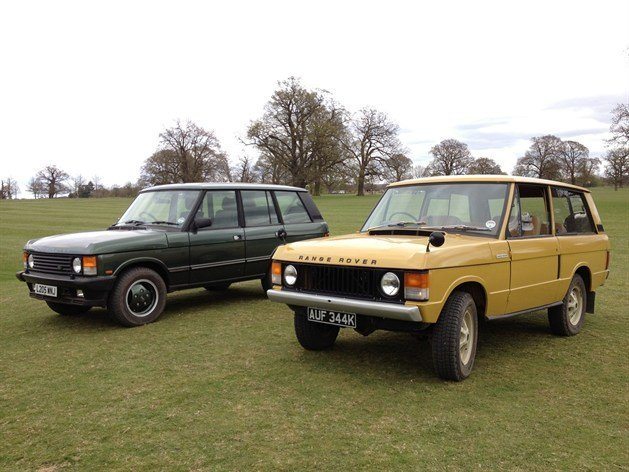
The original Range Rover enjoyed a 26-year production run, during which time it was almost unanimiously regarded as the best off-roader in the world... bar none. That's an exceptionally long production run. To see just how well the Rangie held up during such a long run, we compare a 1971 and 1993 cars. Does purity of design win over luxury equipment levels? Read on...
The back story
Land Rover's post-Evoque era has been a story of consistent success. Sales records are continually broken, profits are rocketing, and demand for the company's ever expanding model range has never been higher. Younger readers might think this is a new phenomenom for the maker of the 'world's best 4x4xfar', but similar success befell Land Rover during the early 1970s in the wake of the launch of the original Rangie. At £1998, it offered a combination of power, torque and all-round ability that no other car at this price point came close to matching.
The V8 powered all-weather Range Rover defined the SUV class, and charmed two generations of monied owners thanks to its all all round classlessness. Our 1971 car perfectly encapsulates the ambitions and desires of its engineering genius creator Spen King, as well as its stylist David Bache. And it should come as no surprise that minimalist examples such as this are the ones that everyone seems to want - enjoying burgeoning values, and massive demand from classic buyers who've recently switched on to its charms.
For the first ten years of its life, very few changes were made to the Range Rover - not because its maker didn't want to make them, nor because buyers didn't want them. The Range Rover remained largely untouched as it was starved of investment by a parent company - British Leyland - that was in dire straits. However, because of the sheer inherent brilliance of the Range Rover, when those improvements - five-doors, automatic transmission - were belatedly introduced, buyers lapped them up anyway.
And the 1993 Vogue we have pitched against the '71 original is pretty much the ultimate product of the Range Rover's extended Indian summer of sales. All its missing is the 108in wheelbase stretch, air suspension and soft dashboard of the very last cars... It comes with four-speed automatic transmission, air conditioning, power steering, windows and central locking, features which the 1971 car lacks. So why is it worth so much less?
On the road
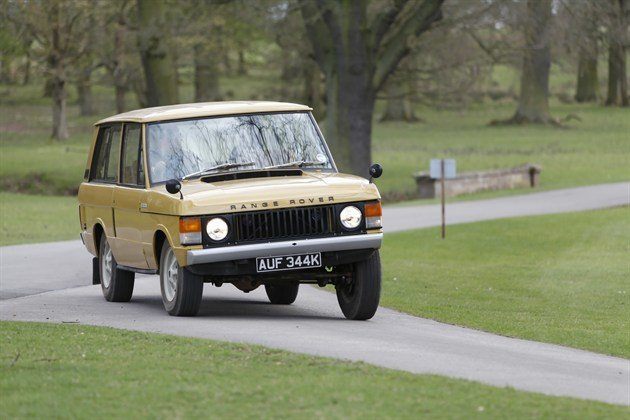
Jumping into the 1971 Range Rover it's easy to appreciate what it was about this car that so enraptured buyers back in 1970. The lofty driving position that's now seen as quite normal really was something new back then - enjoyed by lorry drivers and farmers, and certainly not those with Bank Manager-sized budgets. But that one aspect of the Range Rover driving experience really is central to its appeal - you sit high, enjoy near unimpeded visibility with the steering wheel pretty much in your lap. The view over the ridged bonnet is still unique.
The Rover V8 fires up with a lazy, slightly uneven, rumble. Engaging a baulky first via a long-throw gear lever and heavy clutch, driveaway is smooth, but not for those who dislike heavy controls. The cumbersome feel of the '71 Range Rover isn't improved come the first corner - without power steering, the huge, spindly wheel is quite an effort to turn, especially at parking speeds. But not only is it heavy, but it's also indirect and woolly. And once you're in the corner, be prepared for lots of body roll (see above). It's not as bad a situation as it might appear, as the damping is superb, and you never feel like you're not in control.
The sloppy steering and soft ride might be necessary for those needing to bridge the Darrien Gap, but it's far from ideal when cruising up the King's Road. But once underway and out of the city, you'll love the cosseting suspension and comfortable seats. This is clearly the perfect car for covering long distances - even without the benefit of overdrive or a five-speed gearbox.
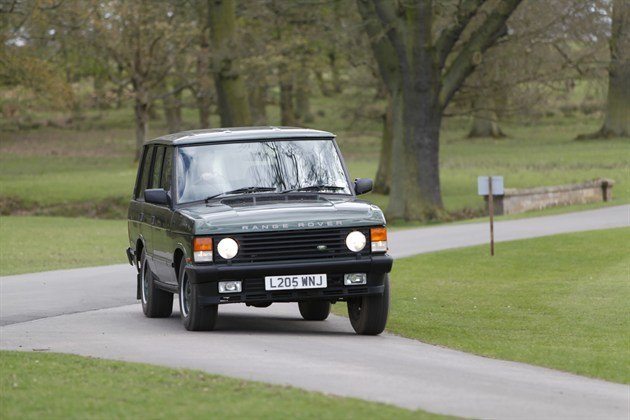
By 1993, when our Vogue rolled off the line, the Range Rover was a very different beast. It had been developed very much as a luxury car, and one that any Mercedes-Benz S-Class or BMW 7-Series owner might not feel too alienated by. So there's a plushly-trimmed cabin, plenty of equipment, a good sound syatem, and if you'd plumped for the SE model, leather seats. Since the company discovered that buyers were more than happy to pay a premium for class, the price went up, as did the Range Rover's aspirations.
So, although when you jump into the '93 car, you're undergoing the same procedure of stepping up into the car and settling into a firm captain's chair with that wonderfu view forward, somehow it all feels much more homely, and - dare we say it - usable. And it also feels reassuringly familiar.
But you can also appreciate the huge improvements that have been made along the way. Thanks to fuel injection, you start it up, and the 3.9-litre immediately settles into a smooth, near-silent idle. Then you slide the T-bar selector of the ZF autobox into 'D', lift your foot gently off the brake, and onto the light, adjustable throttle, and smoothly set off. It's so dignified compared with its more agricultural forbear. It's much easier, too.
Thanks to lightweight power steering and a small thickly padded wheel, the '93 car is a whole lot more manoeuvrable, feeling more lightweight on its toes. Come the first corner, it still suffers from body roll (see below), but far less so than the early car - and thanks to steering that's more road-biased, you always feel just that little bit more in control.
And that's what really marks out these two cars. The original Range Rover is brilliantly conceived, but the refined 1993 version allows you to enjoy all the best bits without the suffering from the failings.
Verdict
Let's not beat around the bush here. The Range Rover is brilliant. As a piece of design, it was - and is - so brilliantly fit for purpose, and looks so good, that we can completely understand just why a model of it was displayed in the Louvre, and why it also went on to enjoy such a long and fruitful life. As an off-roader, it was unrivalled - and yet, on the road, it was also masterful. A rare combination that few cars - even to this day - manage with quite so much verve.
And with that in mind, it's easy to declare the 1993 car the better of the pair. How could it not be? After all, it's more usable, more comfortable, better equipped, faster, better-made (yes, really), and thanks to much improved colour palettes, more timeless to look at, too.
But then, the original is just so unsullied as a piece of industrial design; as a concept; as a piece of art, that we can fully understand why the hose-clean 1970s car has so many classic car fans. However, we'll be happy to buy a later car and enjoy the creature comforts that we all enjoy in our cars today, because - let's face it - few of us will be venturing too far off-road in our classic Range Rover. Leave the early cars to the truly affluent, as they head towards investment-grade status, get the best you can, while adhering to our buying guide, keep it clean and well-serviced, and enjoy years of pleasurable motoring ahead.
Land Rover Range Rover (1970 – 1996) Buying Guide
Good
- 'Classic' Range Rover, warts and all. Some people still love them.
- 14' 8" long by 5' 10" wide and from 1724kg to 2150ky for 15' 3" Vogue LSE
- 4-cylinder 90bhp 2343cc diesels the most economical (later models from October 1989 had 2.5 litre 119bhp VM diesels, then from November 1992 111bhp 2.5 litre Land Rover TDI diesels).
- Old carburettor 3528cc V8s to October 1989 had only 130bhp; 3947cc V8s from October 1989 had 185bhp; 4,278cc V8 from October 1992 had 200bhp. Unrivalled cross country performance until the replacement model arrived.
- Final metallic-blue 25 individually numbered '25th Anniversary' models the most valuable. Very Low 2 out of nine point death rate from accidents in this model.
Bad
- V8s guzzle petrol.
- Misfires destroy 'cats'.
- Litany of quality problems which may or may not have been sorted by previous owners.
- The three-door CSK (Charles Spencer King) was an interesting aberration - not wanted at 2-3 years old, but might develop a cult classic following in years to come if kept clean.
- Air suspension fitted to LSE and Vogue SE can be troublesome.
- In June 2001 Land Rover was rated by Motor Warranty Direct as Britain's 2nd worst out of 22 marques for warranty claims (www.warrantydirect.co.uk) LandRover had joint highest average cost in warranty claims for cars up to 10 years old in 2002 Warranty Direct index
Watch
- The ladder chassis needs to be totally sound check particularly the rear crossmember and if it crinkles, walk away. Always crawl underneath to check the chassis and running gear for off-road damage.
- Does the car list and does it run true on a test drive?
- The steel floors and wheel arches rust, but there are lots of proprietary repair panels available or you could just have them patchwelded.
- The upper and lower tailgates are notorious for it but again numerous replacement options are available.
- Most of the outer panels are aluminium, which don’t rust of course, but there’s usually electrolytic reaction where alloy meets steel.
- It’s also prone to damage and too much means a careless driver or a real offroad enthusiast – avoid both.
- Those V8 engines go on forever if they’ve had regular oil changes; check for a thick sludge in the filler cap. If you find it, you’ll also find gunged up tappets and a shot camshaft.
- It also needs a 50/50 coolant mix all year round to prevent the aluminium block from corroding.
- Diesel engines are fairly reliable but won’t stand being overheated. They’re prone to cylinder head warping and cam belts snapping.
- Make sure the gadgets work, because fixing them can be very expensive.
- Signs of severe usage. Check suspension bushes for wear. Steering box may be worn.
- Look for oil leaks from gearbox, transfer case and axles. Make sure rear axle breather not blocked.
- Make sure VM diesel not suffering from cracked cylinder heads (white smoke from exhaust; mayonnaise under oil cap).
- Sludge on dipstick is really bad news - a walk-away fault because it means the oil has rarely been changed.
- Look for dog damage to leather seats and trim. Scuff marks and trim damage from shooting trips.
- Alloy parts of body won't rot, but steel parts and chassis do, particularly at the back, and electrolytically corrode where the steel and alloy meet.
- Check Boge rear suspension unit.
- Avoid cars with specialist, heavy duty tow bars (may have been pulling a 6-ton yacht or, worse still, a mobile hamburger stand). Try to buy town cars rather than country cars. May be reliable, but you can still expect niggling faults.
Recalls
- 1998: (Jan '94-Mar '97 build): airbag may go off inadvertently.
- 5-5-2005 Safety Recall R/2004/069: possibility of stress cracks in plastic fuel tank of V8 petrol modeld. build dates 15-4-1993 to 7-9-1998.
Land Rover Range Rover Classic
| 0–60 | 14.0 s |
| Top speed | 100 mph |
| Power | 132 bhp |
| Torque | 185 lb ft |
| Weight | 1750 kg |
| Cylinders | V8 |
| Engine capacity | 3528 cc |
| Layout | F4WD |
| Transmission | 4M |
